

$11.9 Billion in Plain Sight
What Indo-Pacific Command’s Unfunded Priority List Tells the Defense Technology Market
Reading INDOPACOM's Unfunded Priority List
At the Honolulu Defense Forum in January 2026, Admiral Paparo told a standing-room audience that "there could be a war of necessity anytime between now and August 1 of 2027, and there can be a war of choice anytime after August of 2027" — referencing the 100th anniversary of the People's Liberation Army. He named three "meta trends" reshaping modern warfare: information and cognitive operations, the democratization of drones, and penetrating strike and precision effects. His deputy, Lt. Gen. Rudd, wrapped those into what he called a "mega trend" — ubiquitous competition for networks. That framing is worth keeping in mind when you read the numbers that follow.
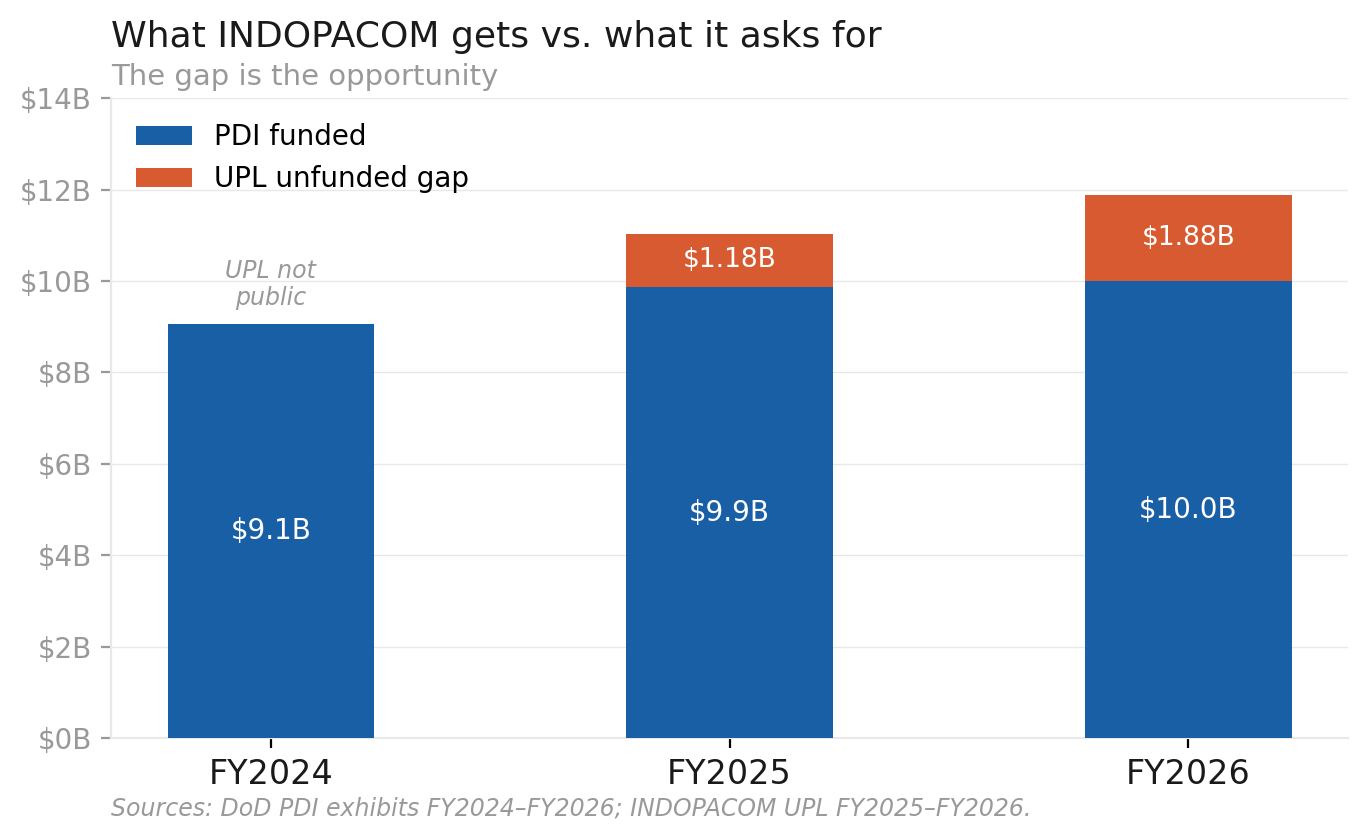
Every year, each combatant commander submits an Unfunded Priority List to Congress — a statement of what the commander needs beyond what the President's Budget provides. The UPL is not a gap list. Programs on it may already receive base budget funding through service accounts; the UPL represents the commander's case for additional investment at the margin. It tells Congress: here is where the budget falls short of what I need, and here is where I would put the next dollar if I had it. INDOPACOM's FY2026 UPL totals $11.886 billion.
That number sits on top of the Pacific Deterrence Initiative — the portion of the DoD budget that Congress tracks as Indo-Pacific spending. The FY2026 PDI exhibit totals $10 billion, up from $9.9 billion in FY2025 and $9.1 billion in FY2024. Together, the PDI and UPL represent roughly $22 billion in stated demand for the theater — the funded baseline and the commander's marginal priorities combined. It is worth noting that even the PDI does not capture the totality of theater spending; a January 2026 GAO report found that the PDI exhibit can present an inconsistent mix of programs due to unclear selection guidance, and that it is developed in a separate process from INDOPACOM's own independent assessment. The FY2026 NDAA fully funds the PDI and layers significant additional authorities on top — $1 billion for the Taiwan Security Cooperation Initiative, direction to co-develop uncrewed and counter-uncrewed capabilities with Taiwan, a statutory program for defense industrial base integration with Indo-Pacific allies, and munitions provisions requiring stockpile assessments for simultaneous multi-theater conflicts.
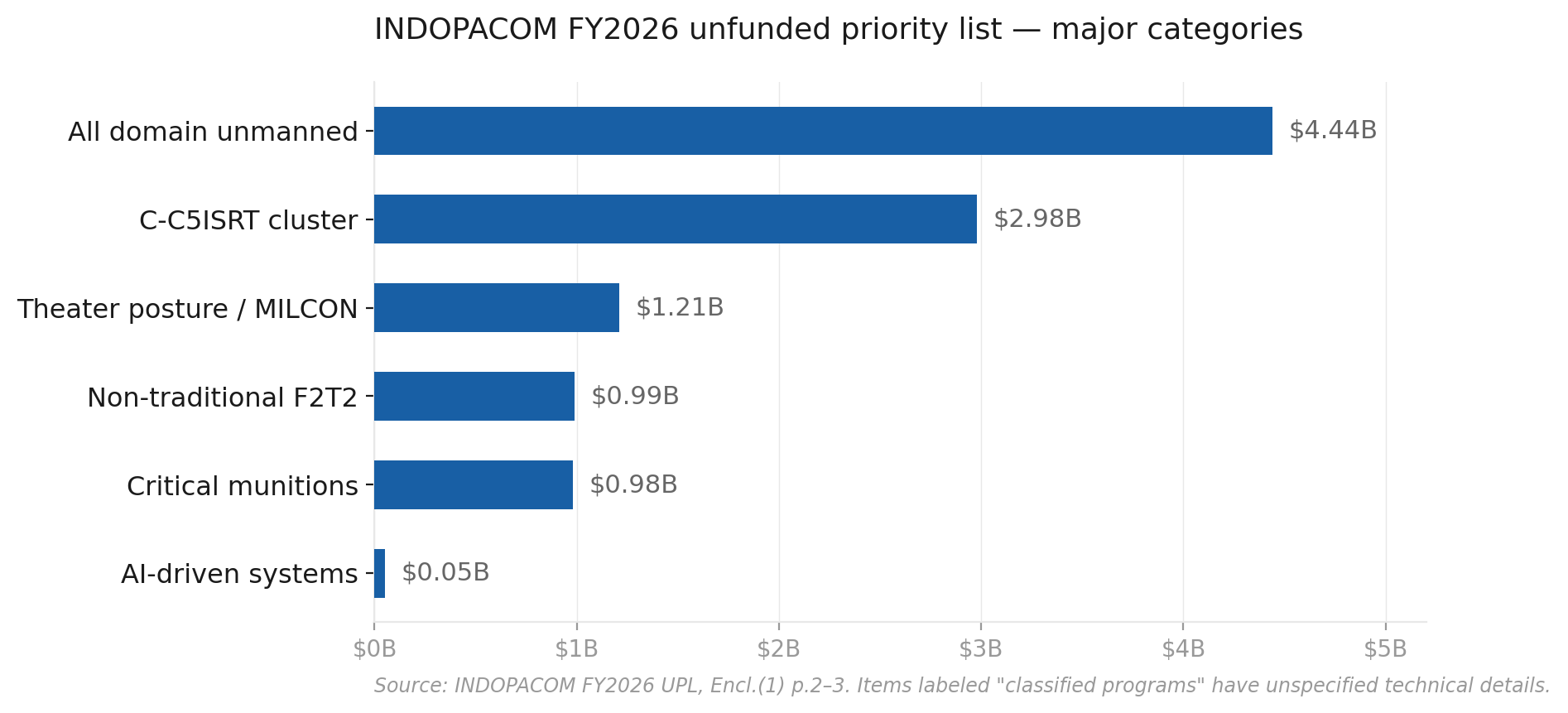
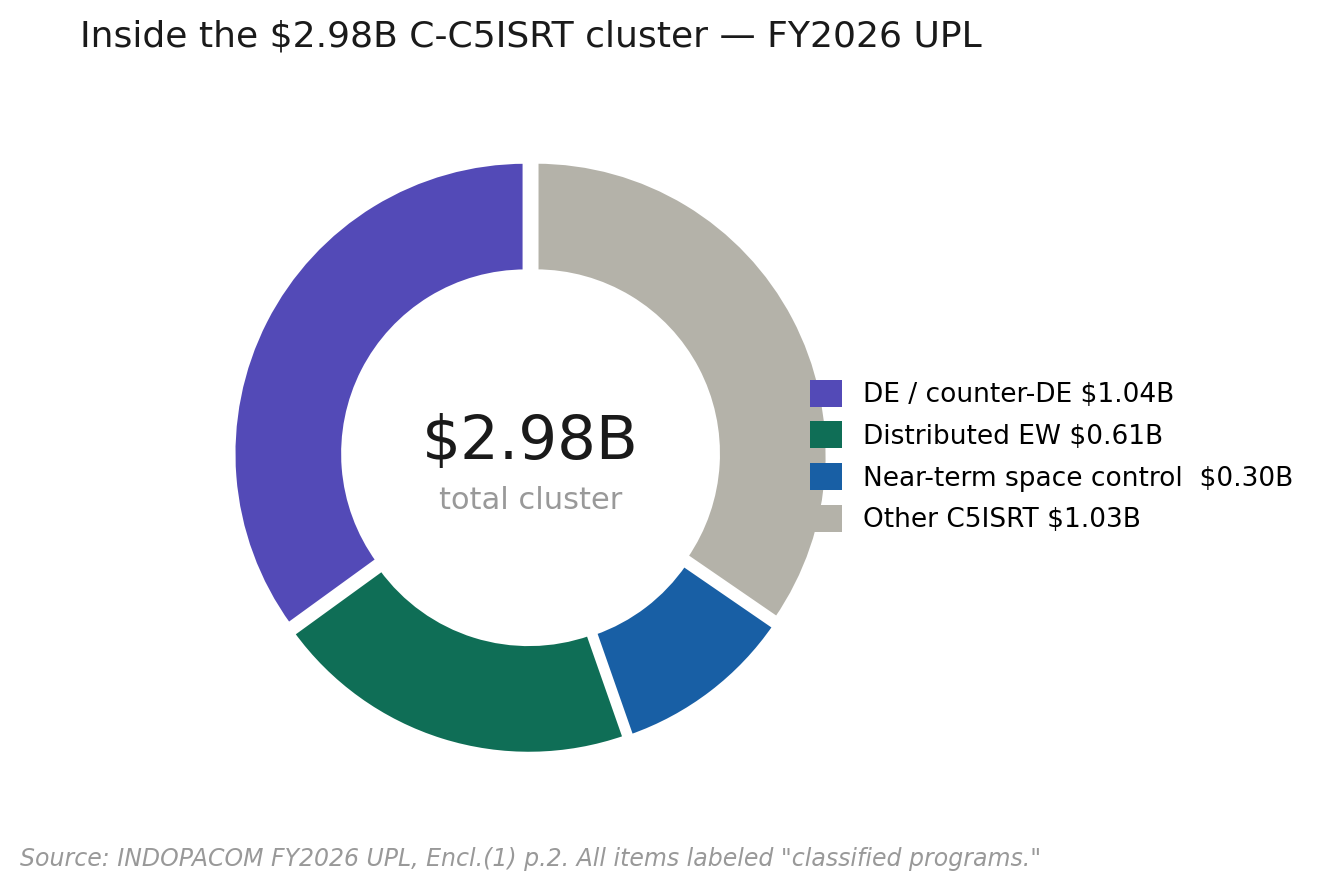
So what does the commander prioritize at the margin? The largest single UPL line item is $4.44 billion for All Domain Unmanned Systems — nearly 40% of the entire list. System composition and quantities are classified, but the dollar figure is not. Next: $2.98 billion for the C-C5ISRT cluster, which includes $1.04 billion in directed energy and counter-directed energy, $607 million in distributed electronic warfare, and $300 million in near-term space control. Then $989 million for Non-Traditional Find, Fix, Track, and Target capability, $977 million in critical munitions, and $1.21 billion in theater posture and infrastructure.
Read the list alongside the FY2025 UPL — which told a similar story at $11.04 billion — and a pattern holds year over year. The commander is prioritizing the connective tissue that makes platforms survivable and useful under denial: the sensing-to-fires chain, the contested logistics network, spectrum resilience, and the sustainment architecture required to keep a distributed force alive across 52% of the earth's surface.
UPL priorities also migrate. The Guam Defense System appeared as Priority 1 on the FY2025 UPL at $573 million; Guam defense architecture now carries a dedicated PDI line set totaling $720 million in the FY2026 exhibit. What the commander prioritizes at the margin in one budget cycle often becomes funded in the next — making the UPL a leading indicator of where appropriated dollars are headed.
Admiral Paparo's April 2025 Senate testimony put specific numbers on the sustainment challenge: the Combat Logistics Force is at roughly 60% of requirement, the tanker fleet is below need, and he explicitly welcomed exploring dual-use uncrewed airlift for contested logistics. In his LANPAC keynote the following month, he framed AI-enabled autonomy and logistics as interdependent problems, calling logistics "a critical challenge in the Indo-Pacific due to the vast distances."
For founders and investors in the defense tech market, the marginal priorities point in consistent directions. Contested logistics is the center of gravity — the shortfall is quantified and the commander has publicly invited dual-use solutions. Unmanned is an ecosystem: autonomy stacks, payloads, comms resilience, launch and recovery, maintainability — the $4.44 billion funds infrastructure around the airframe as much as the airframe itself. Decision advantage software carries a dedicated UPL line (Thunderforge and INDOPACOM HQ AI at $48 million), putting a dollar figure on demand for planning and decision-support tools at the combatant command level. And munitions depth is structural — production acceleration, components, testing, and sustainment, where the throughput problem compounds every year the industrial base doesn't scale.
VVC invests in dual-use technologies across space, sensing, autonomy, cyber, and advanced hardware — categories that map directly to the INDOPACOM priority stack. Several of our portfolio companies operate in domains aligned with the UPL's largest line items, from autonomous systems to spectrum operations. Our team has worked in and around the INDOPACOM theater across prior careers — in operational technology, intelligence and analysis, and security cooperation — and we continue to track the command's public signals as part of how we source, evaluate, and support investments. We read the UPL because the problems in it are the problems our companies are built to address.
The defense venture community spends considerable energy trying to decode what the Pentagon wants. For INDOPACOM, the answer is published annually, with prices attached. The hard part was never finding the signal. It was taking it seriously.
Sources:
INDOPACOM FY2026 Unfunded Priority List (Encl.(1), June 2025) [LINK: https://www.taxpayer.net/wp-content/uploads/2025/07/INDOPACOM-FY26-UPL.pdf]
INDOPACOM FY2025 Unfunded Priority List (March 2024) [LINK: https://www.taxpayer.net/wp-content/uploads/2024/03/fy25-indo-pacom-unfunded-list.pdf]
DoD FY2026 Pacific Deterrence Initiative Exhibit [LINK: https://comptroller.defense.gov/Portals/45/Documents/defbudget/FY2026/FY2026_Pacific_Deterrence_Initiative.pdf]
FY2026 NDAA Executive Summary, Senate Armed Services Committee [LINK: https://www.armed-services.senate.gov/imo/media/doc/fy2026_ndaa_executive_summary.pdf]
Admiral Paparo, SASC Posture Hearing Transcript (April 10, 2025) [LINK: https://www.armed-services.senate.gov/imo/media/doc/4102025fulltranscript.pdf]
Admiral Paparo, HASC Posture Statement (April 2025) [LINK: https://armedservices.house.gov/uploadedfiles/indopacom_posture_statement_2025.pdf]
Admiral Paparo, Honolulu Defense Forum (January 2026) [LINK: https://www.defenseone.com/threats/2026/01/three-meta-trends-are-reshaping-warfare-indopacom-commander-says/410666/]
Lt. Gen. Rudd, TechNet Indo-Pacific (October 2025) [LINK: https://breakingdefense.com/2025/10/ubiquitous-competition-of-networks-is-a-mega-trend-in-the-pacific-indopacom-deputy/]
Admiral Paparo, LANPAC Keynote (May 2025) [LINK: https://www.army.mil/article/285494/indopacom_commander_underscores_importance_of_land_forces_deterrence_and_ai_in_indo_pacific_security]
GAO-26-107698: Defense Budget — Clearer Guidance Needed for PDI (January 2026) [LINK: https://files.gao.gov/reports/GAO-26-107698/index.html]
CRS: The Pacific Deterrence Initiative [LINK: https://www.congress.gov/crs-product/IF12303]
CRS: Defense Primer — U.S. Indo-Pacific Command (February 2026) [LINK: https://www.congress.gov/crs_external_products/IF/PDF/IF12604/IF12604.4.pdf]
